A fire burning in the hearth makes a home feel relaxed and romantic. Before choosing fireplaces and stoves for a modern interior, however, look beyond appearance and review the technical requirements. Depending on the chimney and heating system, a fireplace can serve as a focal point in the living room, help heat the entire house, or even support hot-water production. Below, we look at the main types of fireplaces and stoves: classic open fireplaces, heat-storage stoves, electric fireplaces, gas fireplaces, hot-air systems, and water-bearing fireplace inserts for central heating.
Fireplaces and stoves for the modern home

Where should the stove be placed?
It is often best to place a stove on an interior wall or toward the cooler north side of the house. This helps keep heat inside the insulated envelope of the building. Many modern fireplaces are visible from several sides and become a highlight of the room. With bioethanol fireplaces, placement is more flexible because they do not require a flue and produce warmth without a conventional masonry or metal firebox. They are often integrated into furniture or mounted on the wall. They are light, flexible, and space-saving.
Three-sided fireplaces and stoves

Ideally, a stove should be positioned so heat can reach the areas you want to warm. Its size must suit the room, the building condition, and the chimney. For solid fuels, choose materials with a high calorific value, such as coal, wood, or pellets, while remembering that they produce smoke and ash. Liquid fuels, such as oil, can provide strong heat output, but they also require safe exhaust handling. Biofuels are a cleaner alternative because they do not produce smoke or soot.

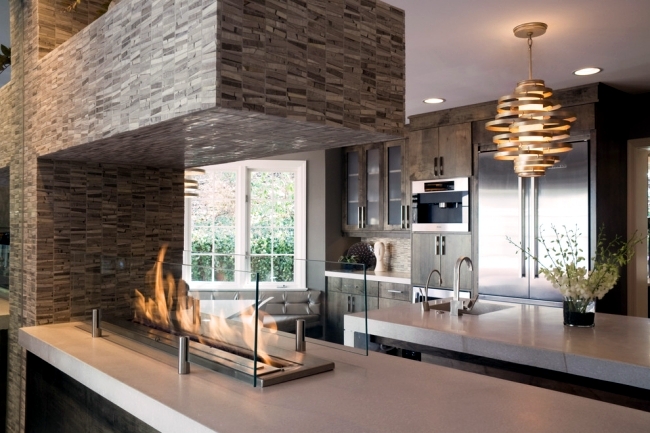
Open fireplaces are less popular today because ash can make cleaning difficult. A current interior trend favors multi-sided glass fireplaces and closed gas fireplaces, which allow the flames to be seen from different areas of the room. Keep fire risks low by maintaining at least one meter of clearance from flammable objects.
Pay special attention to the chimney

Contrary to popular belief, the most important part of the system is not only the fireplace itself but also the chimney. The flue must be planned with both safety and comfort in mind. A specialist should design, build, and maintain the chimney. Buying fireplaces and stoves with a poor exhaust system is expensive in the long run and can create a serious fire hazard.

The chimney has two functions. First, it carries exhaust gases away from the living space. Second, it supports combustion by creating draft. Many combustion chambers include controls that increase or reduce the oxygen flow, slowing or accelerating the burn. Chimney height also matters: the higher the chimney, the stronger the draft and the more intense the combustion can become.

More draft is not always desirable. In some Finnish-style masonry heaters, combustion is deliberately slowed and the heat is stored in several chambers, so warmth is released over a longer period instead of disappearing quickly through the flue. If smoke blows back into the room, check whether the chimney is blocked.
Finally, do not forget maintenance. The schedule depends on the fireplace type and fuel. Bioethanol fireplaces need little maintenance because ethanol burns without smoke. With other fireplaces and stoves, remove ash before each heating season and have the chimney cleaned at least once a year.
Water-bearing fireplaces can heat the whole house

Beyond comfort and atmosphere, fireplaces and stoves can offer practical benefits. A fireplace can serve as a whole-house heating system when it uses a hot-air generator or a water-bearing insert. The insert is connected to the central heating system through a buffer tank. When linked to the heating circuit, a water-bearing fireplace can warm other rooms and may also prepare domestic hot water. Fireplaces with thermal storage are useful because they continue releasing heat after the fire has gone out.

The different types of fireplace:
• Classic fireplace – The classic open fireplace gives direct contact with the fire. Its main disadvantage is low efficiency, often only 10 to 20 percent, meaning much of the wood is consumed without effectively heating the room. Because there is no barrier between the flames and the living space, the fire risk is higher. A traditional open fireplace is usually built on site from refractory brick rather than bought as a ready-made unit.

• Heat-storage stove – These stoves have a closed combustion chamber, which improves efficiency. A glass door increases safety, though efficiency can drop sharply when the door is left open. Most models are designed to burn wood, coal, or briquettes.


• Gas fireplaces – Gas fireplaces can be efficient and relatively low-emission. Depending on their size, they provide roughly 3 to 8 kW of heat output. They require either a gas connection or bottled liquefied petroleum gas such as propane. They may be less decorative than a wood fire, but their efficiency is good.


• Electric fireplaces – Electric fireplaces are increasingly popular because they avoid many disadvantages of wood-burning models. They are clean and easy to install: plug the unit into an outlet and it is ready to use. Many models include a remote control for adjusting the heat output, and they can be integrated into furniture or mounted on the wall.


• Bioethanol fireplaces – Bioethanol fireplaces create a warm atmosphere and act as a decorative accent in the home. Burning ethanol does not produce smoke, soot, or toxic fumes, so no flue connection is required. These open-flame fireplaces heat a room quickly, though the effect is usually short-lived. Designers offer them in many shapes and sizes.



 miranda_shida
 Peter Dark
 Yolande A. Bow
 Anna Lohan
 Theresa V. Adams