Every owner of a house or condominium will sooner or later have to deal with the issue of heaters. If a new home is being built, the question arises very quickly, but even when an existing property is purchased, a renovation may make it necessary to buy suitable radiators. A couple of generations ago, radiators were relatively uniform. Today there is an excellent choice, so much so that it can be hard to see the forest for the trees.
Radiator guide: radiant heat for allergy sufferers

There are two fundamental differences between radiators that should be considered. To make heat feel pleasant, it is often advisable to choose a model that produces radiant heat. In these heaters, infrared radiation generates the warmth. The air in the room is not heated first; instead, the rays warm objects and people in the room. One major advantage is for people who react allergically to house dust or pollen, because this method does not stir up dust. With convection, on the other hand, the surrounding air is heated by the radiator and air circulation takes place.
Radiator guide – flexibility

Sectional radiators are typical heating devices found in many older houses and apartments. Because they make it easy to achieve a higher heat output in a room and are inexpensive, they are still very popular, especially when large areas need to be heated.
However, those who do not have allergy problems can of course use a convector heater. These heaters are available in various sizes and models, which has the advantage that personal wishes can be met easily during installation. Residents should note, however, that these models are often relatively expensive.
Tubular radiators for the bathroom – Heating Guide

Tubular radiators are mainly used in bathrooms. They can be found in many designs and are very well suited for drying towels after use. They are also an interesting solution that can be cleaned easily. However, once they are covered with towels, the radiator absorbs part of the heat. The bathroom then needs more heating, which can increase energy costs.
Underfloor heating invisible

Panel radiators are now visible in many properties. They are relatively quiet and have good thermal performance. Underfloor heating systems, on the other hand, are invisible because they are installed in the floor. Rooms can be designed more freely in this case, because no one has to plan around a radiator. The heat is distributed evenly throughout the space; therefore, underfloor heating is often installed in bathrooms where cold corners should be avoided. The floor covering does need to be considered. Ordinary carpet should not be laid over large areas, because it reduces the heating output to a minimum. Special mat systems for underfloor heating solve this problem.


 Theresa V. Adams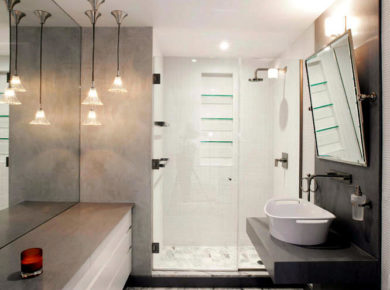
 miranda_shida
 Anna Lohan