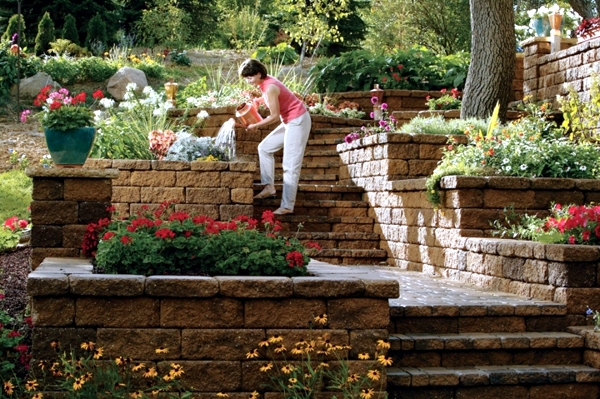
A retaining wall in the garden serves several functions and plays an important role in garden design. It not only supports gardens located on slopes, but also offers an ideal solution for dividing space intelligently. With a small retaining wall, you can separate different garden zones from one another, making room for a patio, flower beds, and a vegetable garden even in a limited area.
Retaining wall in the garden – the effect of natural stone

A retaining wall in the garden can be made from concrete, natural stone, or granite. For a natural look, construction companies often build a concrete retaining wall and then clad it with stone tiles. A dry-stone wall is often the best option, but it is also usually the most expensive. Granite walls are cheaper than natural stone walls and can be built relatively quickly. Limestone is another option; it can be combined with stairs and works especially well for homes on a slope. Lighting is often integrated into the design. It is an eye-catcher on any wall and is especially recommended near the base of walls for safety reasons, since it helps prevent falls in the dark.
Retaining wall in the garden – design ideas

Combine the retaining wall in the garden with planters. Wooden walls can be used as accents or to divide the garden into different zones. Often, a garden wall is built in a semicircular shape to frame the patio, creating a comfortable seating area surrounded by plants and flowers. Garden walls are also often combined with stairs. They are particularly useful for homes on slopes with limited outdoor space. Whichever option you choose, you can make better use of a small garden and create many beautiful, secure places to decorate with plants and flowers. Let these wonderful suggestions inspire you.




 miranda_shida
 Anna Lohan
 Peter Dark


 Theresa V. Adams